Start With These Furnace Thermostat Checks
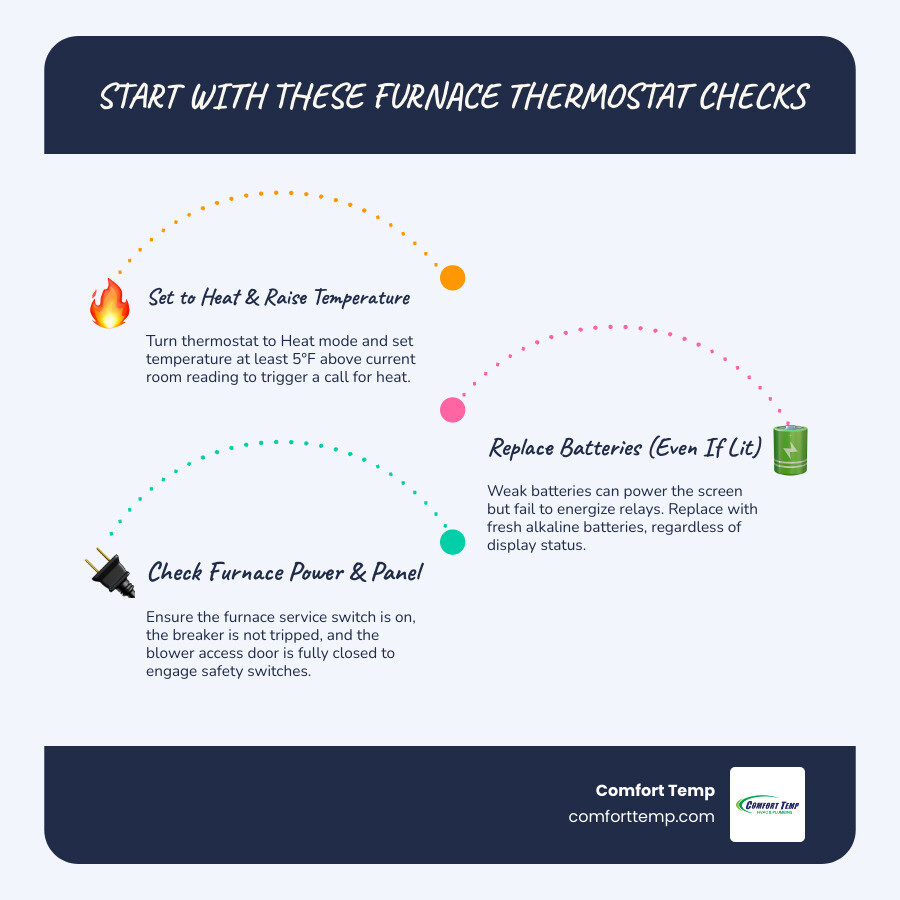
If your furnace won’t respond to the thermostat, check three things first: Set it to Heat and raise the temperature above the room reading. Replace its batteries if it uses them, even if the screen is lit. Then check that the furnace switch and breaker are on and the access panel is fully closed.
A blank screen can mean the thermostat has lost battery or furnace power. If it says “Heat On” but the furnace stays silent, the heat signal may not be reaching the furnace, or a furnace safety control may be stopping it. The checks above can narrow down the problem without opening the unit. Whether evaluating a furnace vs heat pump setup, exploring furnace replacement options, or scheduling professional furnace servicing, understanding these controls helps keep your home comfortable.
Comfort Temp HVAC & Plumbing provides residential HVAC and plumbing in Gainesville, plus commercial HVAC and plumbing in Jacksonville and Orlando. Its technicians are licensed for both commercial and residential plumbing work.
How Low-Voltage Thermostat Communication Controls Your Furnace
When you adjust your thermostat to warm your home, you are not directly igniting the gas burners or activating electric heating elements. Instead, your thermostat functions as an automated low-voltage switch. Most residential heating systems operate across a dedicated 24-volt circuit powered by the furnace itself.
Inside the wall baseplate, color-coded conductors connect specific control terminals between the thermostat and the furnace control board:
- R (Red, 24V Power): Delivers continuous 24-volt alternating current (VAC) power from the furnace transformer to the thermostat.
- W (White, Heat Call): Carries the heating signal back to the furnace control board.
- G (Green, Fan): Controls the indoor blower fan independently.
- Y (Yellow, Cooling): Sends the call for air conditioning to the outdoor contactor.
- C (Blue or Black, Common): Completes the 24-volt electrical loop to supply continuous power to modern digital and connected devices.
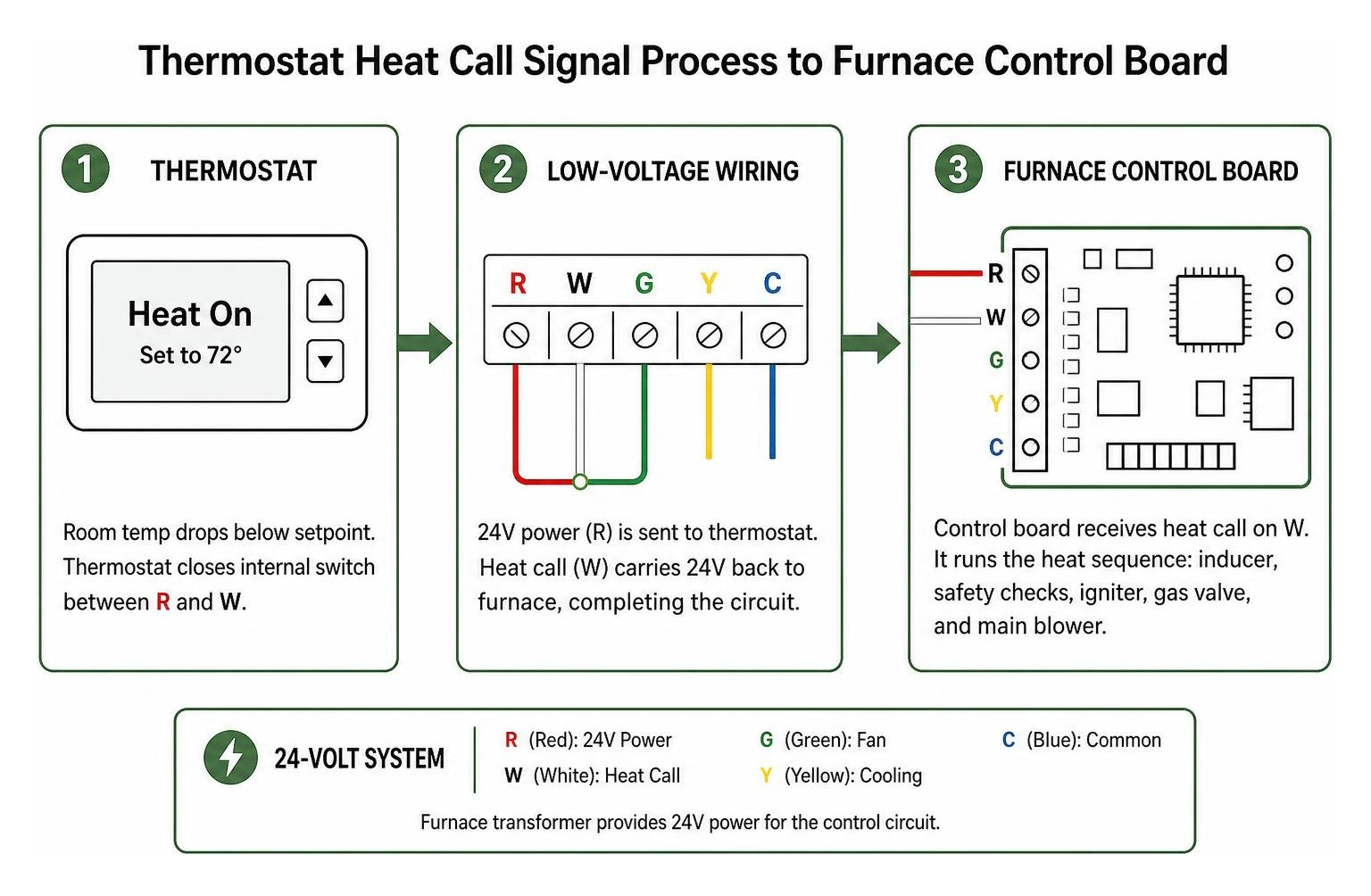
When the ambient room temperature drops below your target setpoint, the thermostat closes the internal contact between the R and W terminals. This completion of the 24-volt loop signals the furnace control board that heating is requested. The control board then initiates its sequence: energizing the draft inducer motor, verifying safety pressure switches, activating the hot surface igniter, opening the gas valve, and eventually turning on the main blower fan. Upgrading to modern hardware offers many conveniences; exploring the benefits of installing a smart thermostat can help you decide if an upgrade fits your home’s setup.
The Role of the 24-Volt Transformer and Control Board Fuse
The heart of this communication network is the furnace transformer. Standard residential power enters your home at 120 volts, but delicate control circuits cannot handle line voltage. A step-down transformer—typically rated at 40 VA (volt-amperes)—converts 120V primary power into a steady 24V secondary output.
To safeguard this transformer from burning out due to sudden voltage spikes or wiring shorts, manufacturers install a sacrificial low-voltage fuse directly on the integrated furnace control board. This component is usually a standard 3-amp or 5-amp automotive-style blade fuse. If low-voltage wires touch or an electrical short develops along the thermostat line, this fuse instantly blows, opening the circuit and stopping power to protect the expensive transformer and control board.
Why Missing C-Wires Cause Smart Furnace Thermostat Issues
Older mechanical thermostats did not need their own continuous power supply because they relied on simple mercury switches or basic mechanical bimetallic coils. Modern smart thermostats, however, feature backlit displays, Wi-Fi radios, and complex processing chips that require continuous electricity.
Without a dedicated C (Common) wire to provide a direct return path to the furnace transformer, many smart units attempt “power stealing”—pulling tiny trickles of current through the heating (W) or cooling (Y) lines without drawing enough to activate the equipment. Under heavy network loads or severe weather demands, power stealing often fails. This results in intermittent Wi-Fi disconnects, erratic system behavior, or sudden screen shutdowns. Installing an approved common wire adapter or having a professional pull a dedicated C-wire ensures uninterrupted operation.
Top Symptoms and Causes of Furnace Thermostat Issues
Identifying whether heating trouble originates at the wall control or within the furnace cabinet saves valuable diagnostic time. In many cases, if you notice your furnace blowing cold air, the thermostat may simply be configured incorrectly or losing voltage under load.
| Observed Symptom | Likely Thermostat Issue | Underlying System Cause | Recommended Action |
|---|---|---|---|
| Completely Blank Display | Dead batteries or complete loss of 24V power | Open blower door switch, tripped breaker, blown 3A/5A fuse, or clogged drain float switch | Replace batteries; verify furnace breaker; call a technician if fuses blow repeatedly |
| Display Says “Heat On” (Furnace Silent) | Thermostat calling for heat, but signal interrupted | Built-in delay timer active, broken W wire, failed control relay, or furnace safety lockout | Wait 5 minutes for compressor/system delay; have a professional inspect control wiring |
| Room Temperature Inaccurate | Internal sensor drift or poor placement | Thermostat located near drafts, sunny windows, or heat sources; dust buildup inside casing | Check with secondary thermometer; schedule professional relocation or sensor calibration |
| Furnace Short Cycling | Incorrect cycle rate settings or poor power supply | Power-stealing voltage drops, loose wiring splices, or dirty furnace air filter causing overheating | Replace air filter; contact a specialist to verify low-voltage loop stability |
Blank Screen Despite Furnace Having Power
A sudden blank screen on a hardwired thermostat usually points to an interrupted 24V circuit. If your thermostat relies on internal batteries, replacing depleted cells resolves roughly 50% of blank screen complaints immediately. When fresh batteries do not restore the display—or if your unit is powered exclusively via system wiring—the 24-volt circuit has lost continuity upstream.
Common triggers include:
- Blower Door Interlock Switch: If the furnace access panel is jarred loose or improperly seated after a filter inspection, the safety switch opens, severing all 120V line power and downstream 24V power.
- Tripped Condensate Float Switch: In high-efficiency condensing furnaces, a clogged drain line causes water to back up into the safety pan, tripping an inline float switch that breaks the low-voltage loop.
- Blown Low-Voltage Fuse: An intermittent short across the thermostat cable blows the control board’s blade fuse, cutting power entirely.
Thermostat Says “Heat On” but the Furnace Does Nothing
When your thermostat proudly displays “Heat On” or illuminates a flame icon, its internal logic believes it has called for heat. If the furnace does not respond after several minutes, the issue often stems from one of the following:
- Built-in System Delays: Many modern thermostats incorporate a 5-minute protective delay to prevent short cycling.
- Pinched or Broken Control Wiring: If the white (W) wire is severed behind the drywall by picture hanging or trim nails, the thermostat closes the circuit internally, but the voltage never arrives at the furnace terminal.
- Corroded Splices: Loose wire nuts or corroded splices in crawl spaces create excessive electrical resistance, dropping voltage below the threshold needed to actuate the furnace board’s relays.
- Furnace Ignition Lockout: The furnace received the signal, attempted ignition, but encountered an internal fault (such as a dirty flame sensor or failing igniter), entering a temporary safety lockout.
When to Contact a Comfort Temp Specialist for Furnace Thermostat Issues

When furnace thermostat issues persist, professional diagnostics are the safest and most reliable path to restoring heat. For ongoing comfort and seasonal reliability, staying informed on seasonal furnace safety updates helps you understand why heating systems need expert attention during sudden cold snaps.
Why Professional Diagnostics Matter
Furnace thermostat issues often involve low-voltage wiring, control board components, and safety interlocks that require specialized training to evaluate safely. A Comfort Temp technician can:
- Verify Operating Mode and Setpoint: Confirm the thermostat is correctly set to Heat and that the target temperature is properly calibrated against the actual room reading.
- Test Battery and Power Delivery: Check whether aging batteries are suffering from voltage sag under load, leaving insufficient energy to latch the internal relay that closes the R-to-W connection.
- Inspect Power Switches and Breakers: Verify that the primary circuit breaker labeled “Furnace” or “HVAC” in your electrical panel is fully switched to the ON position, and that the furnace service switch was not accidentally turned off.
What a Comfort Temp Technician Will Evaluate
- Blower Access Panel Seating: A technician will inspect the furnace cabinet door to ensure it is flush against the frame and properly engaging the push-button safety interlock switch.
- Thermostat Subbase and Terminals: The faceplate is gently detached from its wall-mounted backplate so a specialist can check for dust buildup and verify that all wire leads remain firmly clamped into their respective screw or push-in terminals.
- Central Air Filter Condition: A severely clogged air filter restricts airflow, causing high-limit safety switches to trip and shut down burner operation while the thermostat continues calling for heat. A professional can identify this and recommend the correct replacement.
Rather than risk misdiagnosis or electrical hazards, contact Comfort Temp HVAC & Plumbing for expert furnace thermostat diagnostics and repair. Our licensed technicians provide residential HVAC and plumbing in Gainesville, as well as commercial HVAC and plumbing in Jacksonville and Orlando.
When to Stop Troubleshooting and Call a Professional
While basic battery swaps and setting checks are straightforward, internal electrical diagnosis and gas system troubleshooting involve serious safety considerations.
Stop troubleshooting immediately and contact a licensed specialist if you encounter:
- The Smell of Natural Gas or Fuel: If you detect a rotten-egg odor near the furnace or vents, evacuate the home immediately and call your gas utility provider and emergency services.
- Repeatedly Blown Control Board Fuses: If a replacement 3A or 5A fuse blows instantly upon restoration of power, a direct short circuit exists in the low-voltage wiring or an internal relay coil has failed.
- Sparking, Burning Odors, or Melted Wire Insulation: Any sign of thermal damage requires specialized diagnostic tools to prevent electrical fires.
- Line-Voltage Equipment (120V/240V Thermostats): Baseboard electric heaters and certain fan-coil systems utilize high-voltage wall controls. Working on line-voltage systems without professional training poses severe shock hazards.
When systems near the end of their operational lifespan, exploring modern energy-efficient heating equipment can restore reliable performance. For urgent heating breakdowns across North Central Florida, reaching out for emergency heating repair in Gainesville guarantees prompt, professional restoration of your system.
Frequently Asked Questions About Furnace Thermostat Issues
Can weak thermostat batteries stop heat even if the screen is lit?
Yes. Digital LCD displays require only tiny microamps of current to display numbers, while mechanical switching relays require a significantly higher burst of power to close the internal contacts. Weak batteries may keep the screen illuminated while lacking the voltage needed to actuate the heat relay when a call for warmth occurs.
Why does my control board fuse keep blowing after replacement?
A low-voltage blade fuse on the furnace control board blows because too much electrical current is flowing through the 24V circuit. This is almost always caused by a short circuit—such as a pinched thermostat wire touching bare sheet metal, damaged insulation from rodents, or a failing contactor coil pulling excessive current. Replacing the fuse without locating and repairing the underlying short will simply cause the new fuse to blow immediately.
Why does my furnace ignore the thermostat only on freezing nights?
Cold outdoor temperatures cause building materials and wiring splices to physically contract. If an older home has loose wire nuts or corroded splices in an unconditioned attic, exterior wall, or crawl space, thermal contraction can pull marginal electrical connections apart just as temperatures plummet. Once indoor or ambient attic temperatures rise slightly, the metal expands and reconnects, creating an intermittent, cold-weather-only failure.
Conclusion
Thermostats serve as the primary command center for residential heating, and the majority of heating failures originate in low-voltage control pathways rather than mechanical furnace breakdowns. By systematically checking your thermostat settings, maintaining fresh batteries, verifying cabinet door switches, and scheduling regular professional maintenance, you can keep your heating system running efficiently and reliably through every drop in temperature.
When low-voltage wiring faults, blown fuses, or complex furnace controls require expert attention, trust the experienced team at Comfort Temp HVAC & Plumbing. Comfort Temp technicians are licensed for both commercial and residential plumbing work, delivering dependable residential HVAC and plumbing in Gainesville, as well as commercial HVAC and plumbing in Jacksonville and Orlando. For thorough inspections, diagnostics, and repairs, schedule your next furnace service and repair with our dedicated team today.