Outdoor Climate Drivers and Indoor Air Quality in Orlando
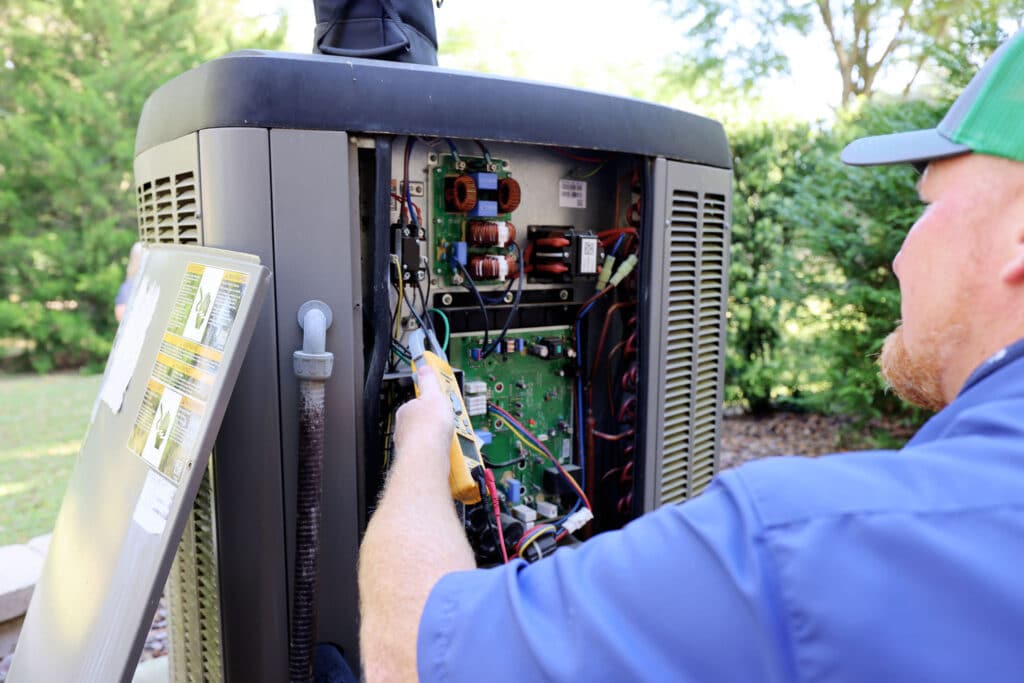
Managing indoor air quality in Orlando comes with a set of environmental challenges that few other cities face. Central Florida’s unique combination of subtropical weather, rapid commercial growth, and high traffic volume directly impacts the air drawn into commercial buildings, retail centers, office parks, and industrial spaces.
The primary ambient driver is ambient humidity. In Central Florida, outdoor relative humidity routinely exceeds 80% during warm months. When commercial heating, ventilation, and air conditioning (HVAC) systems draw in unfiltered or under-treated outdoor air, that moisture enters the building. Without proper moisture control, humidity levels inside commercial properties can spike above 60%, creating the ideal breeding ground for airborne biological contaminants.
Beyond atmospheric moisture, atmospheric particulates pose a constant challenge:
- PM2.5 Concentrations: Orlando’s fine particulate matter (PM2.5) concentration frequently measures around 13.3 µg/m³, which is roughly 2.7 times the World Health Organization (WHO) annual guideline value. These micro-particles are small enough to penetrate deep into respiratory pathways.
- Air Quality Index (AQI): Orlando typically records an Air Quality Index (AQI) rating around 59 US AQI, categorized as “Moderate.” While not inherently hazardous for every individual, moderate AQI levels mean sensitive populations can suffer discomfort during extended outdoor or under-filtered indoor exposure.
- Traffic Soot and Tire Tread Dust: Heavy highway corridors like I-4 and the SR-408 produce significant vehicular exhaust, nitrogen dioxide (NO2), and microscopic rubber tread particles from high-volume traffic.
- Construction Particulates: Ongoing urban expansion and commercial development release airborne silica, concrete particulate matter, and soil dust.
- Regional Wildfires: Seasonal prescribed burns and wildfire smoke drifting across Central Florida bring fine ash and carbon residue into urban air pathways.
To stay updated on localized outdoor particulate trends and pollen spikes, business owners often monitor resource guides like Outdoor air quality and pollen forecasts in Central Florida or track regional air metrics via Micanopy, FL Air Quality & Pollen, alongside monitoring neighboring air indices like La Crosse, WI Air Quality Index. When outdoor air metrics dip, properly designed commercial ventilation becomes your property’s primary line of defense.
Common Pollutants Impacting Indoor Air Quality in Orlando Facilities
When outdoor contaminants breach a building envelope, they combine with indoor emissions to form complex chemical and biological cocktails. Commercial property owners and facility managers in Central Florida frequently encounter several distinct pollutant categories.
Volatile Organic Compounds (VOCs) represent one of the most persistent chemical hazards in modern commercial spaces. VOCs off-gas continuously from synthetic carpets, fresh paints, adhesives, commercial cleaning chemicals, manufactured office furniture, and unvented varnishes. Even seemingly benign items like scented candles or cheap air fresheners release volatile hydrocarbons directly into enclosed space air.
Biological contaminants pose an equal threat. In Orlando’s humid air, excessive indoor moisture allows active mold spores to colonize building materials, drywall, ceiling tiles, and commercial ductwork.
The following breakdown outlines the primary indoor air contaminants observed in Orlando commercial spaces:
| Contaminant Category | Primary Sources in Commercial Buildings | Common Symptoms & Health Impacts |
|---|---|---|
| Volatile Organic Compounds (VOCs) | Off-gassing carpets, paints, furniture, cleaning solvents, varnishes | Headaches, dizziness, eye/nose irritation, nausea |
| Mold & Fungal Spores | High humidity (>60%), roof leaks, condensate overflows, damp drywall | Allergic rhinitis, persistent coughing, throat tickle, asthma flares |
| Fine Particulate Matter (PM2.5) | Infiltrated exhaust, highway dust, tire wear, indoor printers/copiers | Respiratory tract irritation, reduced lung capacity, fatigue |
| Carbon Monoxide (CO) | Malfunctioning gas water heaters, indoor combustion, parking garage seepage | Dizziness, disorientation, sudden illness, severe neurological risks |
| Nitrogen Dioxide (NO2) | Gas appliances, commercial kitchen equipment, outdoor traffic draw | Airway inflammation, increased risk of respiratory infection |
Florida Health Regulations, Complaints, and Official Resources
Navigating state and local regulations is an essential duty for Florida commercial property managers, building operators, and landlords. The Florida Department of Health (DOH) oversees state environmental health frameworks, working alongside county health departments to educate the public on indoor environmental conditions.
However, business owners and tenants should note specific boundaries regarding official state services:
- No Direct Mold Testing: The Florida Department of Health does not provide direct mold testing or onsite indoor inspection services. Multiple Florida counties explicitly list “NO PROGRAM” for dedicated indoor air quality home or facility testing.
- Orange County Health Department: For general health inquiries and localized guidance, facility operators can contact the Orange County Health Department IAQ consultation line at 407-289-9715.
- Commercial Lodging and Rental Complaints: Concerns regarding poor indoor air quality, persistent mold, or sanitation issues in commercial rental properties, apartments, hotels, and motels are regulated by the Florida Department of Business and Professional Regulation (DBPR). Tenants and business operators can contact the DBPR complaint line directly at 850-487-1395.
If issues escalate without resolution, tenant safety or sanitation grievances can also be directed to consumer assistance channels like the Department of Agriculture and Consumer Services.
Testing Methods for Indoor Air Quality that Orlando Property Owners Should Use
Evaluating the air inside an Orlando commercial property requires structured methodologies rather than quick visual guesses. Because pollutants range from microscopic mold spores to invisible chemical gases, property owners utilize a spectrum of professional diagnostic procedures.

Professional laboratory air sampling remains the definitive standard for assessing environmental safety. Certified technicians deploy calibrated air pumps, spore traps, and sorbent tubes throughout commercial suites to pull precise volumes of air through specialized filter media. These samples are sent to accredited laboratories for thorough microscopic and chemical evaluation.
Standard environmental testing evaluates:
- Spore Trap Analysis: Identifies background airborne mold spore counts and compares indoor species against outdoor ambient baselines.
- VOC Gas Chromatography: Measures total volatile organic compound concentrations and isolates specific chemical compounds off-gassing from building materials.
- Fiber Identification: Scans air samples for hazardous airborne synthetic or mineral fibers, often necessary prior to structural renovations.
- Combustion Gas Metrics: Measures carbon monoxide and fuel-combustion sub-products to verify burner safety.
Facility operators evaluating regional environmental inspection standards should ensure testing follows accredited laboratory protocols and industry-certified assessment procedures.
Continuous Air Quality Monitoring vs. Laboratory IAQ Testing
Building managers often ask whether continuous air quality monitors can take the place of laboratory sampling. Both tools serve distinct, highly valuable purposes in facility management.
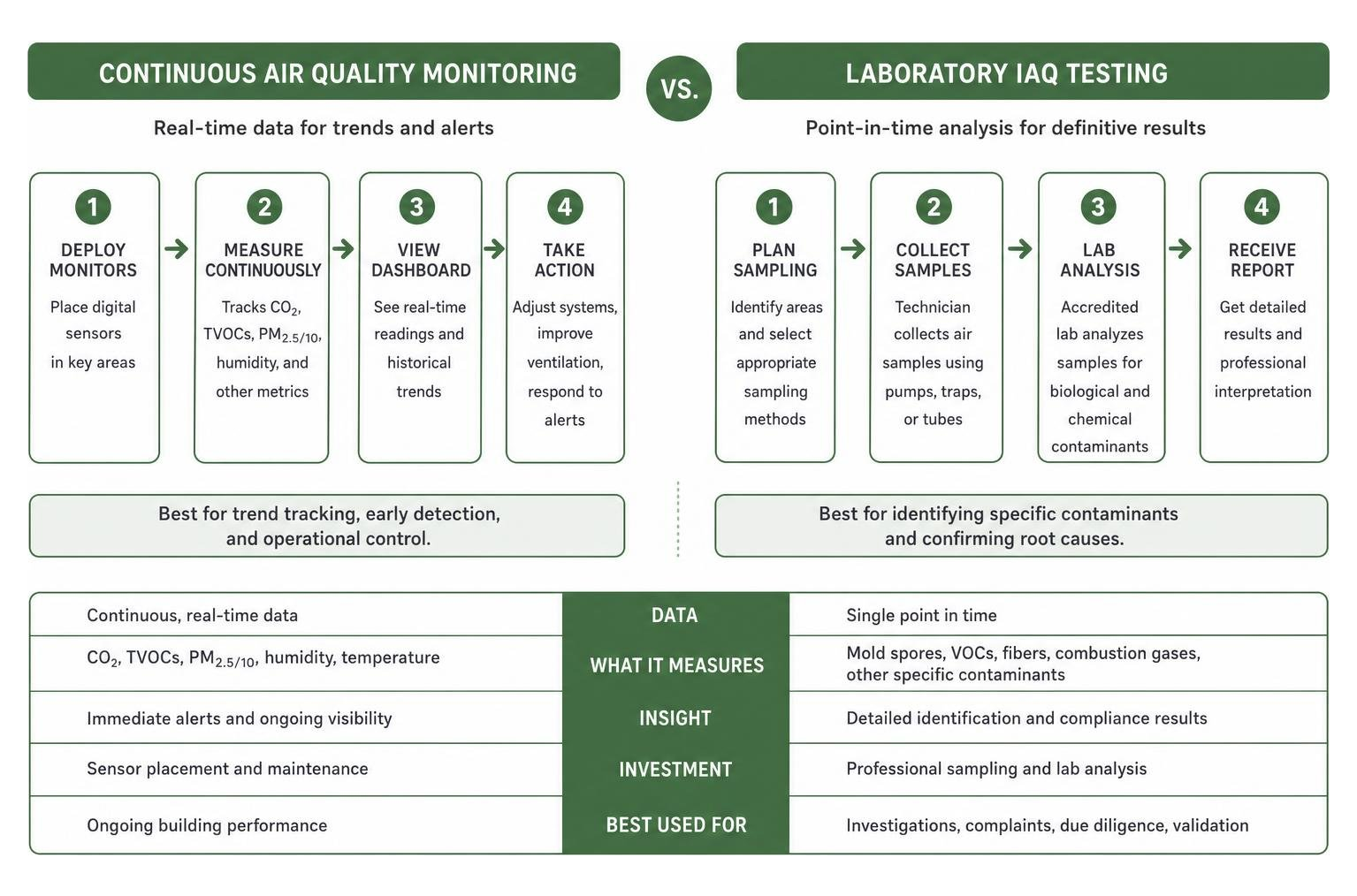
- Continuous Air Quality Monitoring: Involves installing digital sensor devices across office zones. These monitors measure real-time shifts in relative humidity, carbon dioxide ($CO_2$) buildup, total VOC spikes, and general particulate metrics ($PM2.5$ / $PM10$). Continuous monitors excel at identifying trends — such as a sudden rise in carbon dioxide when a conference room fills, or high humidity levels over a weekend when commercial air conditioning cycles down.
- Laboratory IAQ Testing: Involves targeted air sampling conducted by trained technicians. Laboratory analysis identifies exact biological species (e.g., distinguishing harmless outdoor airborne mold from problematic indoor Stachybotrys or Aspergillus) and pinpointing hazardous trace compounds like illicit drug residue or asbestos fibers.
To understand how individual property assessments are conducted, check out our guide on How Can I Test the Air Quality in My Home?.
How to Test and Identify Contaminants in Central Florida
When occupants report physical discomfort or when property managers prepare for commercial lease transitions, a systematic testing protocol protects both building integrity and occupant health.
- Conduct a Visual and Moisture Inspection: Technicians use thermal imaging cameras and digital moisture meters to locate hidden leaks inside walls, drop ceilings, and commercial ductwork.
- Deploy Calibrated Air Pumps: Air sampling equipment is placed in affected zones, control zones, and outdoor reference areas to capture comparative data.
- Analyze Laboratory Reports: Samples are processed by accredited environmental testing laboratories to produce detailed contaminant counts.
- Evaluate Occupational Health Impacts: If building occupants express persistent symptoms like unexplained eye irritation or shortness of breath, managers should encourage them to consult a primary care physician. Medical doctors evaluate physical symptoms first to rule out non-environmental causes before diagnosing building-related illnesses.
Effective Solutions to Improve Air Quality in Commercial and Large Facilities
Improving air quality across large commercial facilities in Orlando demands a proactive strategy focused on mechanical balance, humidity control, and engineered ventilation. Unlike smaller residential settings, commercial properties feature dedicated roof-top units (RTUs), complicated fresh-air intake dampers, and shared duct systems serving hundreds of occupants.
A crucial first step is managing building ventilation and intake airflow:
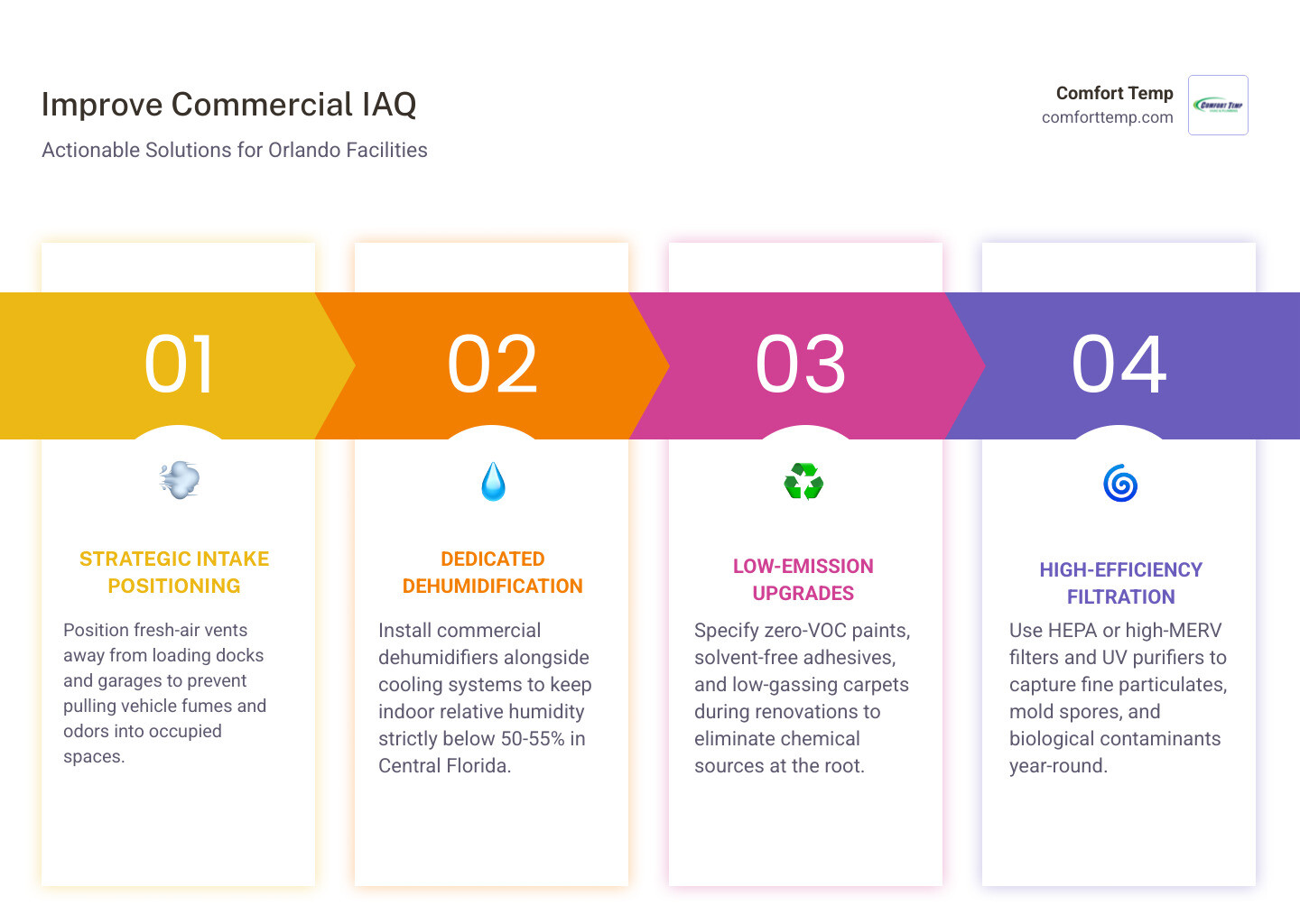
- Strategic Intake Positioning: Ensure fresh-air intake vents are located far away from loading docks, parking garages, and exhaust stacks to avoid pulling vehicle fumes or dumpster odors directly into occupied offices.
- Dedicated Commercial Dehumidification: Because Central Florida outdoor air is perpetually wet, commercial facilities often require dedicated commercial dehumidifiers operating alongside primary cooling equipment to keep indoor relative humidity strictly below 50–55%.
- Low-Emission Upgrades: Specify zero-VOC paints, solvent-free building adhesives, and low-gassing commercial carpets during renovations to eliminate chemical sources at the root.
For detailed operational strategies on optimizing commercial air balance, review our educational breakdown on How to Improve Indoor Air Quality and our detailed reference on Improving Indoor Air Quality: Your Guide to a Healthier Home.
High-Efficiency Air Filtration and Dehumidification Systems
Mechanical ventilation and filtration upgrades represent the most effective long-term defense against airborne contaminants in Orlando facilities.
- High-MERV Air Filtration: Commercial HVAC systems should be retrofitted with high MERV (Minimum Efficiency Reporting Value) filters — typically MERV 13 or higher. These filters trap fine dust, pollen, soot, and $PM2.5$ particulates before air circulates across tenant suites.
- HEPA Filtration Units: In specialized environments, such as medical offices, laboratories, or high-density conference suites, standalone or duct-integrated HEPA (High-Efficiency Particulate Air) filtration systems capture 99.97% of particles down to 0.3 microns.
- Ultraviolet (UV) Air Germicidal Purifiers: Installing UV-C light arrays inside commercial air handler units targets airborne bacteria, viruses, and mold spores growing on cooling coils and drain pans. Unlike water purification systems that filter liquid water supplies, air purification technologies operate strictly within HVAC airstreams to eliminate airborne biological contaminants in humid Orlando conditions.
- Commercial Moisture Management: Excess indoor moisture quickly leads to coil fouling and mold spore growth. Supplemental commercial dehumidifiers maintain stable humidity levels even when A/C units cycle off during mild, rainy afternoons.
Property managers can review equipment options through our comprehensive Whole House HVAC Air Purifier Guide or consult with our specialized commercial team via Orlando HVAC & Air Conditioning Services. For facilities located in our North Central Florida residential service territory around Gainesville, property owners can also check out our Residential Indoor Air Quality Products.
Frequently Asked Questions About Indoor Air Quality in Orlando
Does the Florida Department of Health provide mold testing services?
No, the Florida Department of Health (DOH) does not provide direct mold testing, sampling, or onsite inspection services for private homes or commercial facilities. County health departments, including Orange County (reachable at 407-289-9715), offer telephone consultations and environmental health guidance, but property owners needing physical air sampling or certified lab reports must hire independent environmental testing professionals or commercial HVAC specialists.
How do I file an air quality complaint for a rental apartment or hotel in Orlando?
In Florida, public lodging establishments — including commercial hotels, motels, resort condominiums, and rented apartment complexes — are regulated by the Florida Department of Business and Professional Regulation (DBPR). Tenants and guests experiencing severe mold, persistent moisture issues, or unsanitary ventilation conditions can file an official complaint with the DBPR online or by calling their main consumer line at 850-487-1395.
When should I consult a doctor for symptoms related to poor air quality?
You should consult a healthcare provider if you or your employees experience persistent respiratory discomfort, chronic headaches, unexplained throat tickles, watery eyes, or frequent asthma flare-ups that noticeably improve when leaving the building. Always consult a primary care physician first. A medical doctor can evaluate your symptoms, perform necessary health screenings, and rule out medical conditions before attributing symptoms entirely to environmental factors.
Conclusion
Maintaining clean, safe indoor air quality in Orlando commercial facilities requires constant vigilance against high humidity, fine particle pollution, and chemical off-gassing. By implementing strategic air filtration, installing commercial dehumidification equipment, monitoring real-time air metrics, and conducting routine commercial HVAC system maintenance, property owners can ensure a healthy indoor environment for every building occupant.
At Comfort Temp HVAC & Plumbing, our team specializes in commercial air conditioning, ventilation balance, air purification, commercial plumbing, and 24/7 emergency service across Orlando and Central Florida. While air purification focuses specifically on treating airborne contaminants and HVAC ductwork, and water purification/treatment addresses building plumbing supply lines, our experienced technicians utilize distinct, specialized technologies to maintain both environmental systems independently.
To learn more about protecting your commercial property, visit our central team hub at Commercial HVAC and Plumbing Solutions in Orlando or schedule a commercial facility consultation today!